Listen on
Maine Thrive Voices
Hear the next conversation
One short email when a new Maine Thrive Voices episode goes live. Nothing else — no weekly send, no promotions.
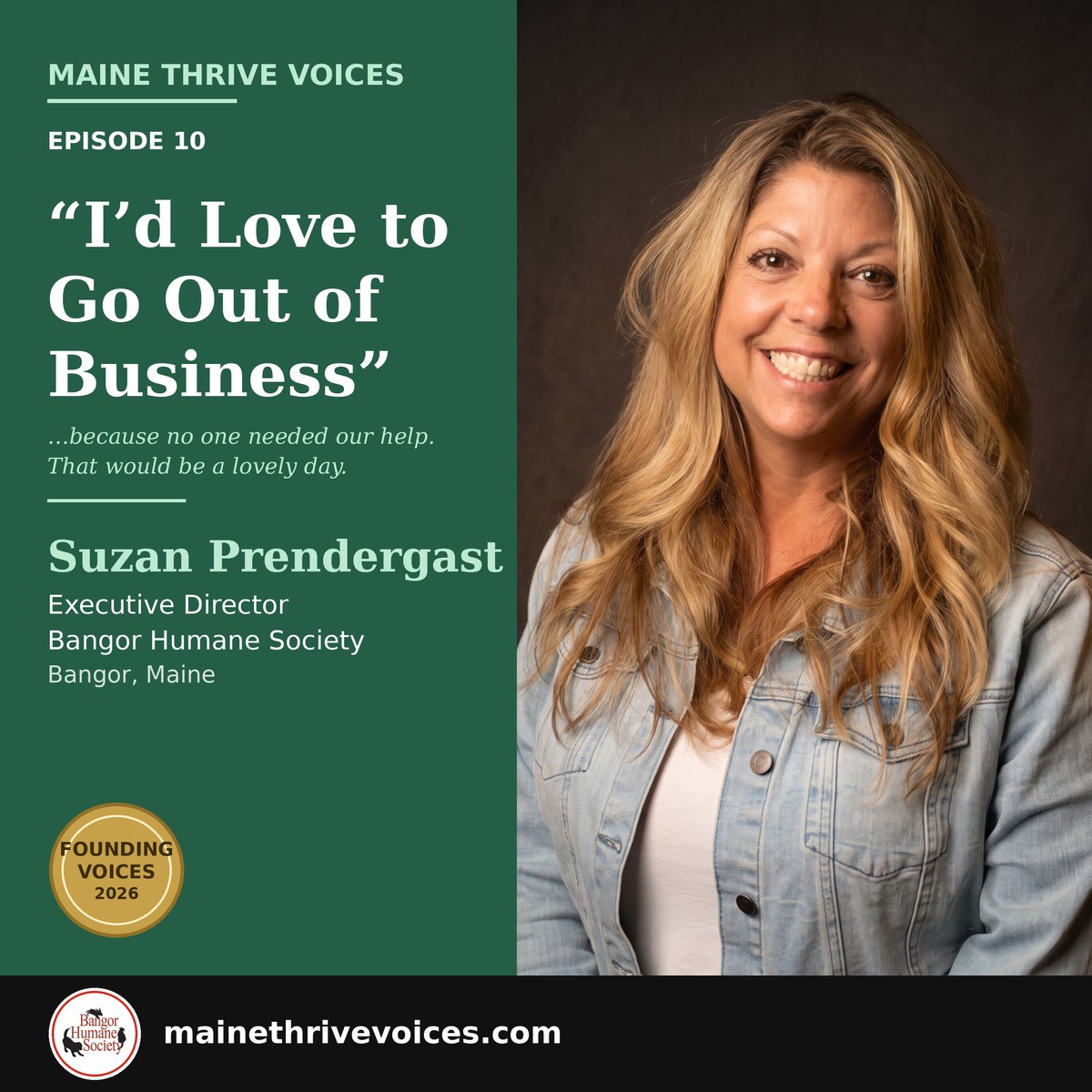
Maine Thrive Insights — Companion Insight | Maine Thrive Voices Podcast | Episode 10 | Guest: Suzan Prendergast, Executive Director, Bangor Humane Society
Ask most leaders about their goals and you'll hear about growth. Ask Suzan Prendergast, and after eighteen years leading the Bangor Humane Society, she'll tell you the opposite.
“I would love for us to go out of business because no one needed our help. That would be a lovely day.”
It's not going to happen — she knows that. But in Episode 10 of Maine Thrive Voices, sitting down with host Sandy Smith, she makes the case that it's still the right goal: a community where every pet has a home, and the shelter on Mount Hope Avenue has nothing left to do.
Until that day comes, here's what the work actually looks like.
A People Helper, Start to Finish
Suzan has spent nearly her entire career in the nonprofit world — years with the American Red Cross in disaster relief before the Humane Society, with what she freely admits was a brief detour into banking. (“I respect all bankers. I wasn't really cut out to be a banker.”) The through line, she says, is simple: she's a people helper. Helping someone's pet is helping the person.
There's a personal story underneath it. When she started at the Red Cross, her son was three and in daycare. If she was going to be away from him all day, she wanted it to count — to make a real difference in the community he was growing up in, so he'd be proud of her. He grew up at the Bangor Humane Society, did his high school volunteer hours there, and still stops in to help when he's in town.
“That to me is a lasting legacy,” she says. “I've passed on my passion for helping others onto my son.”
Disaster Training, Every Single Day
Does the Red Cross background show up in shelter leadership? “Daily. Daily.” The building opens to the public at one o'clock; the team is there at seven in the morning getting every animal cared for first. And when the doors open, nobody knows who will walk through them or with what crisis in tow. Changing priorities, limited resources, delivering the mission no matter the obstacle — disaster relief in miniature, every afternoon.
What the public rarely sees is the complexity between an animal arriving and an animal leaving: personality assessments, medical workups, spay and neuter, vaccines — and what Suzan calls the quiet dignity time, when an animal simply needs to adjust and grow comfortable with new people before it can put its best foot forward. Sometimes that takes days. Sometimes it takes months.
The Honest Truth About “No-Kill”
When Sandy asks about the hardest decision she faces, Suzan doesn't reach for a comfortable answer. The hardest decision — never made unilaterally, always by a group — is when the last humane option in the best interest of a pet is euthanasia.
And she takes the time to explain what “no-kill” actually means, because most people don't know: a no-kill shelter is one with a better than ninety percent live release rate — animals leaving alive through adoption, transfer, or return to owner. At the Bangor Humane Society, the number is three percent, and only after every option has been exhausted: training, veterinary help, behavior work, all of it.
“When you look in the mirror and you ask yourself, 'Have we done everything we can do?' And if the answer is yes, we have — then the answer is fairly obvious. Unfortunately, as in life, most hard decisions are just that. Hard decisions.”
Maine is fortunate, she notes: shelters across the state and New England hold to the no-kill standard, something much of the country hasn't yet reached. “We have more good stories than I have bad stories.”
Everything Changed After COVID
Before the pandemic, the Bangor Humane Society was part of the solution for the rest of the country — transporting adoptable dogs and puppies north from high-euthanasia regions in Georgia, Florida, and other southern states. After COVID, the flow reversed. Local surrenders jumped dramatically, the transport program was suspended and hasn't returned, and the shelter now serves thirty-five towns with a persistent waitlist of families who need to surrender a dog — and exactly 42 kennels to work with.
Her analogy is the one every restaurant owner will recognize: you can't serve more people unless you turn over the tables. She can't help more animals unless adopters turn over those kennels. Adoption has stayed steady — as many going out as coming in — but more dogs are arriving with behavior and health issues, and that lengthens every stay.
The ask is direct: if you're looking for a pet, check your local shelter or rescue group first. And if they don't have what you're looking for — well, Suzan has a line for that too: “If we don't have the kind of cat you're looking for, then you don't really need a cat.”
Eighty Percent Community
Here's the number that surprised even Sandy: the Bangor Humane Society receives no federal funding and no state funding. Programs and services cover just twenty percent of its income. The other eighty percent is local donors and grantors — the community, keeping the doors open.
That structure isn't an accident. The shelter deliberately keeps adoption fees where local families can actually afford them, which means donor dollars are what make affordable adoption possible in the first place.
And the community mission runs deeper than adoptions. The shelter partners with coalitions serving Bangor's unhoused neighbors — providing crates, pet food, and beds at no cost. And through a partnership with Partners for Peace, pets of people entering services for domestic violence can stay at the shelter free of charge until owner and pet can be safely reunited. There's a documented link between abuse of animals and abuse of people, Suzan explains — getting both out of a dangerous home helps everyone recover.
Paws on Parade — and How to Help Right Now
What's she excited about? The biggest fundraiser of the year: Paws on Parade, the first Saturday of October on the Bangor waterfront — a celebration of pets, people, and the bond between them, now in its mid-thirties as an annual tradition. Smaller fundraisers feed into it all season, including a golf tournament this August.
For anyone ready to get involved, her first step is simple: start at the website. Volunteering, donating, fostering, adopting — every link is there, and the volunteer link goes straight to the volunteer coordinator. The shelter runs on more than one hundred active volunteers doing everything from dog walking to laundry (two sets of washers and dryers, running constantly) to board service and veterinary support. “There is a place for everybody at the Bangor Humane Society.”
And the number-one item on the wish list right now? Toys. New or gently used dog and cat toys — puzzle feeders especially. Fresh toys are mental health for a kenneled animal, Suzan says, the same Christmas-morning excitement her own dogs show when she walks in from the pet store. The shelter goes through an exorbitant amount of them.
One more thing worth knowing, which Sandy discloses in the episode: every Monday afternoon, he reaches out to Suzan to select adoptable dogs to feature in the Penobscot Valley Voice newsletter — one more channel the shelter uses to get its animals in front of the community.
The Heartbeat
Asked what she wants Greater Bangor to remember, Suzan lands on this: every day, she walks into a building full of beautiful furry friends and an incredibly passionate group of staff and volunteers doing the very best they can, every minute of every day. Mistakes are human, and they learn from them. Triumphs get applied to the next animal through the door.
“That compassion, love, and dedication is the heartbeat in the blood of this agency.”
Even the shelter's education program carries the long-game version of her favorite goal — camps and student groups spend half-days learning humane care and how to approach animals, so that, in her words, the next generation can put them out of business.
Local Resource — Bangor Humane Society
Adopt, volunteer, foster, or donate — every link starts at the website. Number-one wish list item right now: new or gently used dog and cat toys, especially puzzle feeders. Paws on Parade is the first Saturday of October on the Bangor waterfront.
Website: bangorhumane.org
Hear the full conversation: Maine Thrive Voices — Episode 10 with Suzan Prendergast on Spotify
Community profile: Bangor Humane Society on Penobscot Valley Thrive
Maine Thrive Voices is produced by Smith Digital Solutions, LLC — Maine's Visibility Consultant. Get Found. Get Calls. Get Paid.