Bigger Doesn't Always Mean Better
Patricia Nielsen on growing up inside The Furniture Gallery, earning her seat in the family business, and why the sale is the easy part.
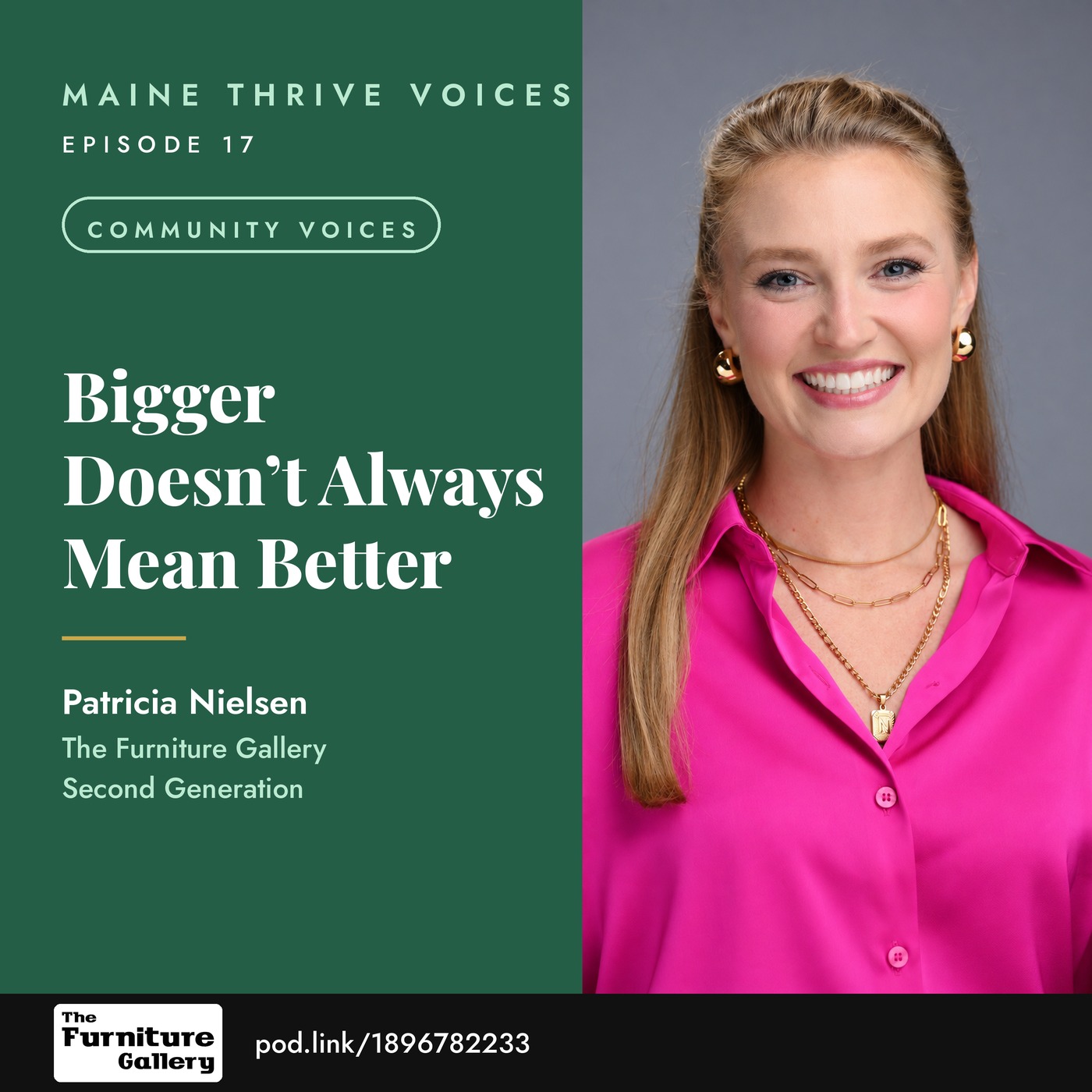
Maine Thrive Voices · Episode 17 · Community Voices · Hosted by Sandy Smith
The Furniture Gallery's Bangor store holds more than an acre of furniture under one roof. It didn't start that way. The business began as a string of small sleep shops — mattresses only, close to nine of them at one point — run by Patricia Nielsen's father, a man who has now spent more than 50 years in the furniture industry. He had worked for another owner of America's Mattress locations and took them over one at a time.
Today the family-owned retailer serves the whole state from four large stores in Bangor, Augusta, North Windham, and Topsham, with delivery anywhere in Maine. Patricia is the second generation, and she touches nearly every part of the business: operations, marketing, logistics, vendor scheduling, deliveries, and customer communication. In this conversation she talks candidly about what that's really like — and what it means to grow without losing what made you worth growing in the first place.
Growing up in the business — and proving you belong there
Patricia doesn't remember a time before the store. She watched her parents work from dusk to dawn, and the work didn't stop at the door; it followed them home to the dinner table. She worked in the business through school and college, then stepped in more fully after earning her master's degree. There was no single moment of decision. "It just happened," she says.
She started at the bottom, sweeping the warehouse, and learned every role in the company along the way. Responsibility grew as her knowledge did — not by a formal handoff, but by earning it. That matters to her, because the hardest pressure in a family business, she says, is the kind you put on yourself.
"Maybe internal pressure that I put on myself to prove that I earned the seat that I'm in, and not necessarily that it's been passed down or just handed to me."
Working beside her dad twelve hours a day has its strains, and the family has gotten better at boundaries. But she's clear about the bottom line: she wouldn't trade it for the world.
Learning to let go of doing it all
Asked to describe a typical week, Patricia laughs that there isn't one. Making sure vendor trucks arrive on schedule, getting delivery trucks out the door, keeping customers informed — it can all land on her desk in the same day. The hardest lesson of stepping into leadership, she says, has been accepting that she can't do it all herself, even when she wants to.
The answer has been leaning on the people around her. The Furniture Gallery has employees who have been with the company for more than 20 years. They know how the family thinks and how to execute. Patricia is learning to trust them to do their jobs, and the company is building systems and procedures so that not everything has to run through her every day.
Four big stores, still not corporate
Four large locations sounds big, but Patricia puts it in perspective: in the grand scheme, it really isn't. What keeps the family feel is access. There aren't layers of management between customers, employees, and the owners. The family is in the stores every day and every week.
That growth didn't hinge on one dramatic turning point. Moving from mattresses into full-line furniture and consolidating nine small shops into four much larger stores was the biggest shift, but Patricia describes it as a lot of little decisions along the way rather than one big bet.
What customers get wrong about furniture
Shoppers arrive far better informed than they used to. Where customers once leaned on salespeople for information, they now walk in having done their research online, and the team's job is to help them narrow the options. Even so, Patricia sees two misconceptions come up again and again.
The first: things that look the same aren't necessarily the same. Construction, materials, and what's underneath the fabric all matter. The cheapest option isn't automatically the worst, and the most expensive isn't automatically the best. The second: no furniture is indestructible. Some pieces are genuinely more durable and more forgiving of kids, pets, and spills — but despite the marketing claims, nothing is truly life-proof.
What customers are loving right now reflects both of those realities. Performance fabrics and washable, removable cushion covers are in demand from families and pet owners. And technology has moved into the living room in a big way — heat, massage, seating with built-in surround sound that moves with your movie, and a new auto-glide recliner that rocks on its own at the push of a button. Patricia says she can't keep that one in stock; a dozen will sell within a week.
Selling is the easy part
"Selling furniture is the easy part. Where we thrive is furniture and service after the sale."
The Furniture Gallery runs its own in-store service department, and Patricia is upfront that the company doesn't claim to be perfect. Damage happens. Delays happen. What defines the business, she says, is how it responds when they do — including helping customers figure out the new technology built into their furniture.
That's the core of her case for buying from a Maine family business instead of clicking "add to cart." Furniture is still a tactile purchase: people want to sit on the sofa, feel the fabric, and lie on the mattress. And when you buy online, you're on your own if that six-piece sectional arrives broken and left in your driveway. With a local store, you're not just buying a sofa — you're buying what happens after it arrives.
Showing up beyond the showroom
The family has grown more involved in the communities it serves, and the large Bangor parking lot has become a gathering place. The company now hosts its annual Trunk or Treat — recently in its third year — built in partnership with local businesses so families know every trunk is a trusted one. It also runs food truck events throughout the year, with proceeds going to a local nonprofit.
The Maine factor
Running retail involves far more than buying a sofa and selling a sofa: freight, buildings, insurance, technology, trucks, and fuel all come with the territory. Maine adds its own challenge. Most of the store's furniture comes from Pennsylvania or North Carolina, and Maine sits well out of the way of most freight routes. Getting product here is simply harder than getting it almost anywhere else.
What thriving looks like
For Patricia, success isn't measured in how much she accomplishes or how many hours she puts in. It's about building a business the family is proud of — organized, rooted in community, and plainly here to stay. Looking five to ten years out, the goal is to grow stronger rather than bigger: better systems, better technology, and a better customer experience, without trading away the local feel. And, she hopes, to position the business to carry on into another generation.
"Bigger doesn't always mean better. We have grown, but we want to make sure we keep that family, Maine, local vibe going."
Key Insights
- Earn the seat, don't inherit it. Learning every role from the warehouse floor up builds credibility a title can't.
- Leadership means letting go. Long-tenured employees and better systems free leaders from being the bottleneck.
- Growth isn't one big bet. The move from nine sleep shops to four large stores came from many small decisions.
- The real product is the service. How a business responds to damage and delays defines its reputation more than the sale.
- Honesty sells. Price doesn't equal quality, and nothing is truly life-proof — saying so builds trust.
- Stronger, not bigger. Accessible owners and a local feel are worth protecting as a business grows.
Connect with The Furniture Gallery
Visit any of the four stores — Bangor (the largest, and the company's hub), Augusta, North Windham, and the Topsham Fair Mall — or shop online.