Living the Life I Choose
Jennifer Goddard came to Maine for her grandchildren, won the Mrs. Maine crown on her second try, and built Thriving Proof in Bangor on one belief: your health is not a hand you’re dealt and stuck with. It’s something you get to influence.
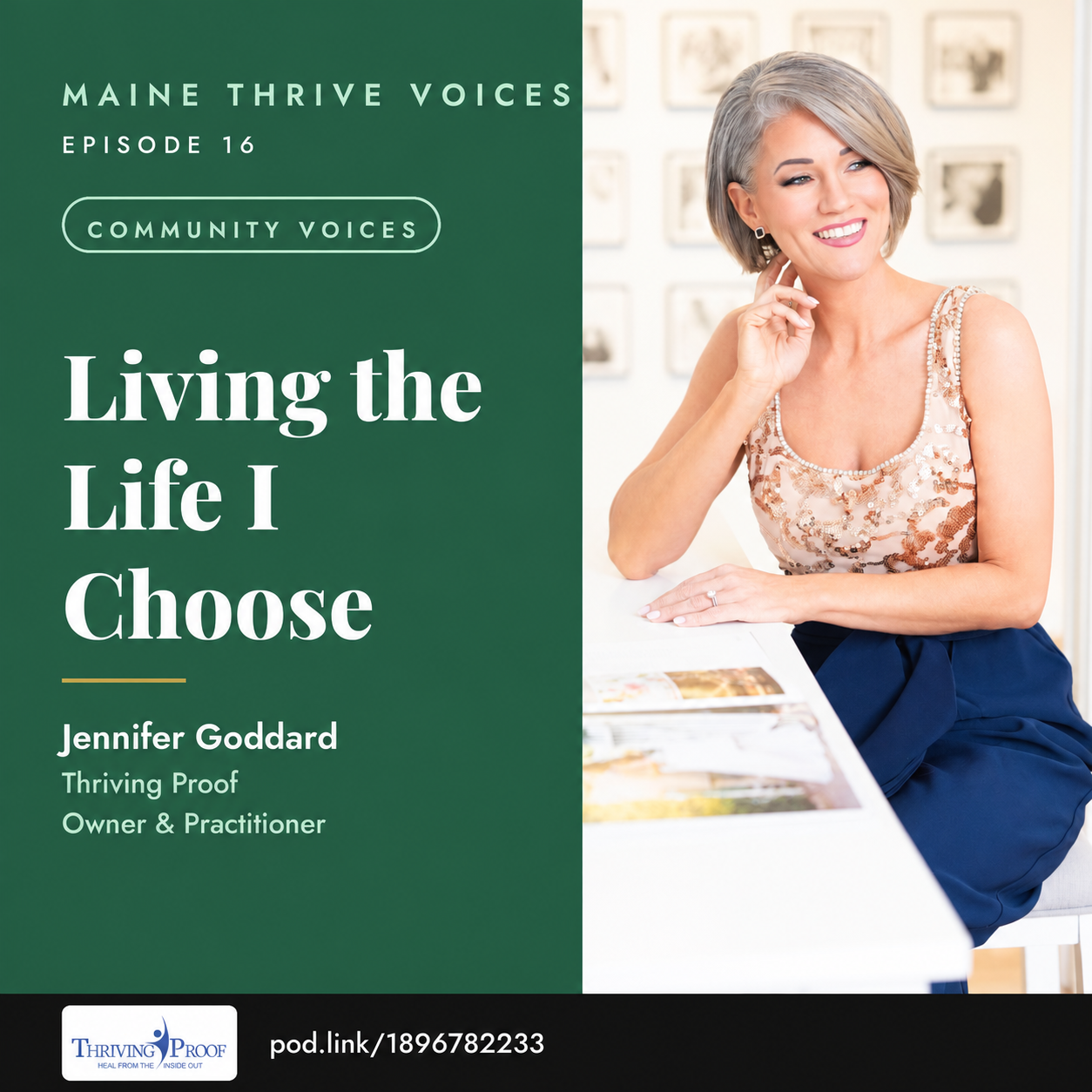
Jennifer Goddard is the owner and practitioner at Thriving Proof, a functional health practice at 33 Penn Plaza in Bangor, where she works alongside Dr. Cassandra Generlette, a board-certified family physician who runs a Direct Primary Care membership. Jennifer is a Certified Holistic Health Practitioner and a certified thermographer, and she holds the USOA Mrs. Maine 2025 title. But the credential she leans on most is her own story. She is, in her words, the proof of what she does.
Four Grandbabies and a Slower Pace
Ask Jennifer what brought her from New Jersey to Maine and the answer is short: her son married a Mainer, and then the babies came. “Now they’ve got four babies,” she says, “so I don’t think I’m going anywhere.”
The biggest adjustment was the pace. She hadn’t realized how fast her old world moved until she stopped living in it, and every trip back to New Jersey makes the gap clearer. At first she wasn’t sure she’d stay. The winters are darker, and she held off on opening a practice until she knew. Then she met a Mainer of her own, married him, and the circle closed. She’s here for good.
Do Something That Scares You
Pageantry found Jennifer, not the other way around. When a recruiter reached out, she assumed the message was spam and laughed it off. Why would anyone compete at her age, against younger women? Then she remembered an old piece of advice: do something that scares you. “As you get older,” she says, “there’s less and less that scares you. So I was like, well, this scares me, so maybe I should do this.”
Her first year, she was terrified, to the point of wanting to run off in the middle of the show. Rather than end the story there, she signed up again. The second time she was nervous in the normal way, not terrified, and she took the crown.
Aging Gracefully
Her platform grew out of that same stretch. For close to a decade, Jennifer had wanted to stop dyeing her hair and let her natural color come through, and a hairdresser had talked her out of it. Between her first and second pageants, she cut her hair as short as she could and let the white grow in, in full view of her social media followers.
Aging gracefully became her message as Mrs. Maine. Three of her grandchildren are girls, and she wants them to grow up comfortable in their own skin. She’s careful to say she has nothing against women who choose color, Botox, or surgery. She colored her own hair for years. Her point is that there should be room for women who want a different way, and that every wrinkle and white hair is part of a process worth talking about.
Representing the state also changed how she sees it. Because Maine is so spread out, she says, it’s easy to assume the whole state looks like your own corner of it. Traveling as Mrs. Maine showed her how different the regions are from one another, and she fell in love with all of them.
Why Thrive Became Thriving Proof
The practice opened in Maine as Thrive Health & Wellness, and people kept mistaking it for a well-known supplement brand with a similar name. Jennifer loved the idea of thriving too much to give it up, so she went back to the drawing board. She thought about the phrase “living proof” and realized that what patients told her again and again was that her own health gave them hope: if she could do it, so could they.
In March 2026 the practice became Thriving Proof. “I am thriving proof of what I do,” she says, “and everybody can be that thriving proof of what’s possible in their health and in their life.”
The Final Straw
Jennifer met Dr. Generlette through BNI, when a physical therapist friend in the networking community told her about a holistically minded doctor she ought to meet. The two stayed in touch, and a patient story turned the friendship into a partnership.
Jennifer always wants her clients under the care of a primary care physician, because as people heal, their medications sometimes need to change. One woman she worked with was managing diabetes on medication and committed to changing her habits. Within about two weeks, her blood sugar was running low, just as Jennifer had warned it might. When the woman called her doctor to discuss adjusting the medication, she was told to eat more carbohydrates instead. She went back to her old routine.
“You find people that want to do the right thing,” Jennifer says, “and instead of being rewarded for it, they’re told no.” She called Dr. Generlette and asked whether she’d ever consider doing things differently. The answer was yes, and the practice took shape from there.
Driving School, Not the Body Shop
Jennifer explains functional medicine with a car analogy. Conventional medicine is a very good body shop, and there’s a time and place for it. Dr. Generlette is an MD and prescribes when it’s needed. Functional care is more like driving school: it looks at the whole body, asks why something is happening rather than only what, and teaches people to work with their own systems so they need the body shop less often. “You don’t want to be using a body shop for your everyday maintenance,” she says.
The first thing new patients notice is time. Visits are included in the membership, with no per-visit copays, and because Dr. Generlette is an MD she can manage much of what would otherwise mean referrals to separate specialists. That means fewer cooks in the kitchen, fewer waits, and better continuity. Labs are also read through a functional lens. Standard lab ranges are designed to catch disease, Jennifer explains, but a lot of dysfunction shows up before something reaches that level. The goal is to catch the problem long before the car breaks down.
The membership has a wait list, partly because the practice also brings on small and mid-sized businesses with self-funded health plans. Jennifer would rather onboard at a pace that lets them keep their promises than compromise the quality of care. She believes the model resonates especially in the Bangor area, where finding a doctor at all can be hard, and where Mainers are asking more questions and expecting more from their care.
Tools Most People Have Never Heard Of
Thriving Proof uses technology that most Bangor residents have never encountered. Thermography reads heat patterns in the body, which can point to inflammation and changes in blood flow. Jennifer uses it to flag areas worth a closer look and to track whether things improve over time, alongside conventional screening. She described one client whose scan lit up over the carotid arteries even though her cholesterol had been called fine. A follow-up carotid ultrasound found significant plaque.
Her two personal favorites are PEMF, which she describes as “a battery charger for your cells” and reaches for especially when bone health is a concern, and the BrainTap headset, which combines light and sound programs. She uses it in her sauna almost every day and calls it a massage for your brain.
DNA analysis, she says, can be one of the most empowering tools of all. Plenty of what families call hereditary may come from shared habits, shared food, and shared stress, which means people often have more control than they think. And where a genetic vulnerability is real, knowing about it lets you be intentional. Her own results explained health struggles she’d had no answers for in her younger years, and changed how she supports her body now.
“It Doesn’t Matter” Is the Myth
The misconception Jennifer most wants to clear up is the one she lived with for years. As a younger woman she carried a long list of diagnoses and went through infertility treatments, and at every stage she was told nothing she did would make a difference. “That was the biggest lie I had ever been told,” she says. Today she is off the medications she once took and free of the health issues she had then, because she changed what she had the power to change.
What you eat, how you live, what you breathe, and what you put on your skin all matter, she says. Your health isn’t a crapshoot.
Living the Life I Choose
Ask Jennifer what thriving means and she answers without hesitating: “Living the life I choose to live, and not the one that I’m told I have to live.” For years she lived in survival mode. Now she gets to decide each day whether to climb a mountain, sit on the couch, or get down on the floor with her grandkids. Her five brothers tease her that she’s trying to live forever. She isn’t. The goal is that every day she’s here, she lives the life she chooses.
For anyone curious, the first step is simple. Visit thrivingproof.com and book a free call with Jennifer. If Thriving Proof isn’t the right fit, she says, she’ll help you find a resource that is.
Maine Thrive Insights is produced by Smith Digital Solutions, LLC in Bangor, Maine. This Insight is a companion to Maine Thrive Voices, Episode 16, part of the Community Voices chapter.