Maine Thrive Insights · Kennebec Valley
"Hopefully They Say It's Still Standing"
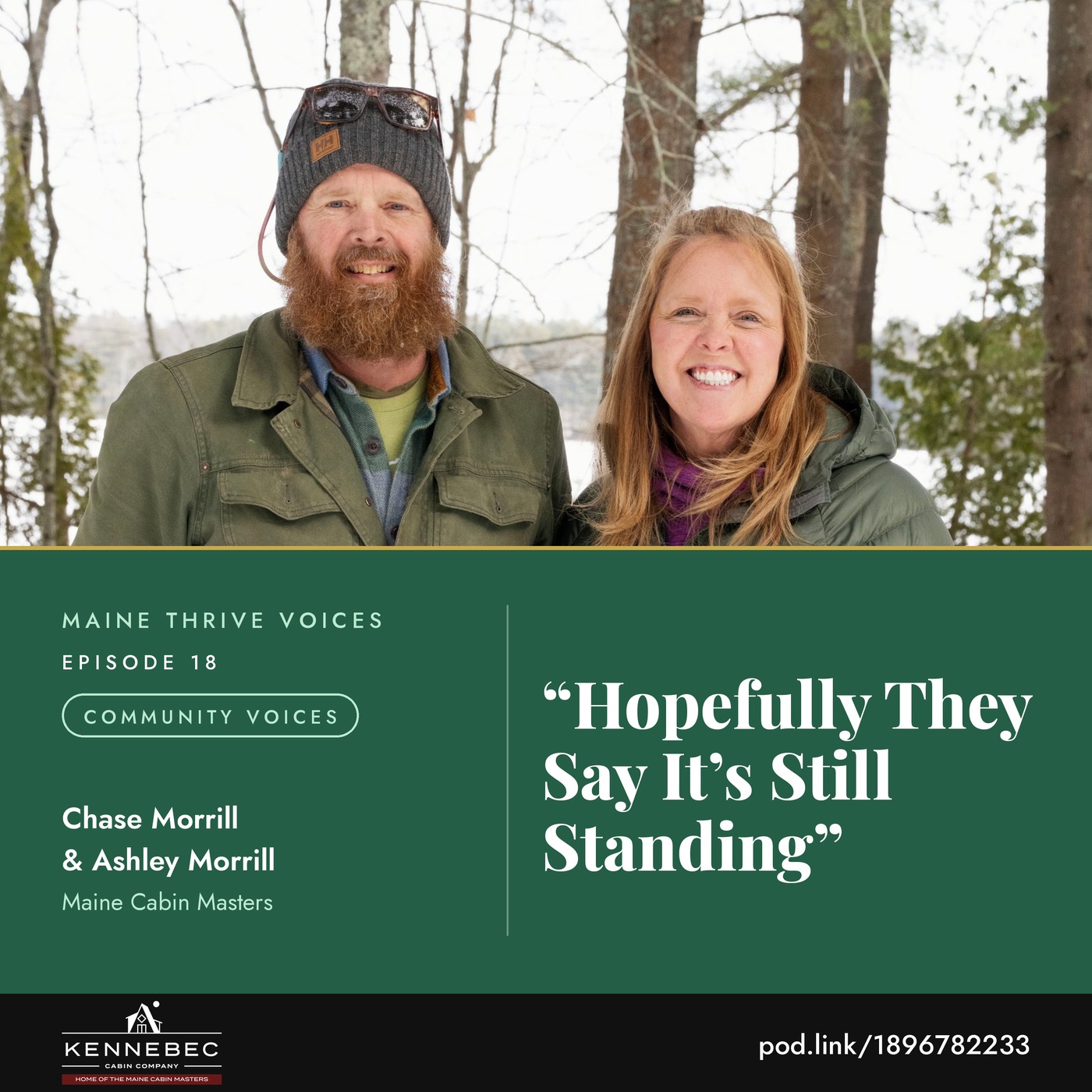
Chase and Ashley Morrill never planned on TV. Eleven years and more than 200 episodes later, Maine Cabin Masters is still a Kennebec Valley carpentry crew first, and it is still saving Maine camps for the families who love them.
From Maine Thrive Voices, Episode 18, our first Kennebec Valley episode · Hosted by Sandy Smith
A cold February day in Wayne
Before the cameras, the crew did what every good Maine carpentry crew does: whatever it took. Cabins, camps, renovations, additions, new construction. Chase Morrill, Ryan, Jedi and Dixie were framing a timber-frame hybrid in Wayne when Chase showed up and asked if they wanted to try "this TV show thing."
The answer was short. Sure, whatever, Chase. Let us get back to work. It's too cold to stand around talking.
A Colorado production company had put out a casting call for a Maine carpentry crew. A friend of a friend passed it along, Chase sent an email asking whether it was real, and a few Skype interviews later, as Chase tells it, "they liked the beards and the accents." A first pilot for the History Channel didn't take. A second, for DIY Network, on the Daggett family camp on Weber Pond in Vassalboro, did. DIY Network later became Magnolia Network, and the show has stayed with it ever since.
"None of us had any TV ambitions. We thought it would be a fun opportunity to do one cabin."Chase Morrill
Ashley joined as the designer for that second pilot. The crew put a microphone on her, put her in a canoe on Weber Pond, and said "go." On an early job in Carrabassett Valley, the two of them went whitewater canoeing past river ice with the sound engineer's very expensive gear on board. They didn't tip. The sound engineer, Pete, is still with the crew today.
Their father is in every episode
Ask what their father taught them and Ashley answers in two words: "All of it." Fans who knew him say they see him all through the show, in the salvaging and recycling, the creativity, and the way the crew treats people.
"He's the reason we're here, to be honest."Ashley Morrill
He built the family home and houses for aunts and uncles, and the kids were always there working, helping and having fun. Chase remembers him as the most patient person he has known, someone who would take the time to show anyone who wanted to learn. Looking back at early episodes, Chase sees his own kids on the job site with tools in their hands, the same way he was raised.
From five people to a Kennebec Valley destination
Kennebec Property Services began as their father's construction company, and it is still the construction arm. As the show grew, fans kept asking how they could buy a T-shirt or support the show, and Kennebec Cabin Company was born as a retail store in Manchester. The Woodshed restaurant followed, along with Ashley's home goods line, Rustic County.
The store and restaurant opened right around 2020, just before the pandemic. "Not the smartest decision," Chase says, "but we made it through." Neither of them expected how much of a destination it would become. The store staff is proudly "teacher heavy," including their old French and biology teachers, their mother and their aunt.
Fans arrive from everywhere. Chase met a couple from Ireland who had seen the show at home and simply had to visit Maine. Do they get tired of it? "No," Chase says. "We wouldn't be here without people watching."
The camps most contractors would tear down
Maine Cabin Masters found its niche in camps most builders would write off. The proximity to the water, or the family's attachment, makes tearing down impossible, so the crew saves them.
"There's a huge level of trust between us and the camp owners to take their spots and to save it."Chase Morrill
Ashley's design work starts with the family: colors to avoid, things not to touch. Once the crew finishes, she and her team bring in upcycled yard-sale finds and work from Maine artists and craftspeople, while keeping what matters. A wall of children's height marks, a mural, a feature a grandfather built. "It might not necessarily mean anything to us," she says, "but to them, it means a lot."
The hard ones
Some builds tested everyone:
- Spruce Mountain ski area. The hardest part wasn't the building. It was the codes and permitting that nearly derailed a project meant to make a local ski area safer. It's open and running again.
- The 1970s geodesic dome and the Fishman camp, one of the worst-condition camps and, at the time, one of the biggest.
- A Moosehead camp reached by walking down the railroad tracks.
- The Snake Island yurt on Togus Pond, for a lifelong friend, built so late in the season that the crew broke through ice on the last day.
- All of season one, when they knew construction but were learning TV on a very steep curve.
"The worse it is for us, the better it is for TV."Chase Morrill
What never makes it on screen
At the height of summer, about 20 carpenters work the jobs, along with subcontractors for landscaping, plumbing and electrical, Ashley's design team and the production crew. The schedule you see on TV is typically 8 to 12 weeks, so most of the work happens before filming starts.
Chase's advice to anyone hoping to be on the show is to have your permits ready. Most of these camps sit in the shoreland zone, and everything has to be in place before day one. Families now apply through mainecabinmasters.com.
Camp culture, rediscovered
Mainers say camp. Everyone else says cabin, which is how the show got its name. Chase says many camps were undervalued before the pandemic. Since then, families have been rediscovering them for the solitude, the clean water and the time together.
Ashley grew up with one party-line telephone at camp. Her advice: keep the cell phones out, as much as you can, and be present.
Local first, and Maine only
National television brought a national audience, but the first thing Chase tells a camp owner hasn't changed: we live here, we were born and raised here, and we're not going anywhere.
"We're first and foremost a construction company that happens to have a camera crew following us around."Chase Morrill
That's also why they turn down requests from other states, including one woman living just over the New Hampshire line who promised you'd never know it wasn't Maine. "If it's not Maine," Chase told her, "we're not going to do it."
Advice for young Mainers in the trades
With kids of his own at that age, Chase keeps it simple. Get a job, start at the bottom and don't be afraid to try. Above all, ask questions. "If you don't know what to do, the only way you're going to learn or improve is to ask." Even if carpentry doesn't stick, he says, those are skills for life, something you can always go back to.
What they hope people say
After more than 200 episodes, Chase and Ashley still get nervous at the key handoff, because the families truly don't see the camp until that moment. Ashley hopes people can feel the love and the fun the crew put into every camp. Chase's answer was shorter:
"Hopefully they say it's still standing."Chase Morrill
His bigger hope is that each camp is still being used and loved years from now.
Lightning round
Favorite Maine lake: Clearwater Lake, where they were raised.
Can't-live-without tool: Anything battery operated.
Best camp meal: A hot dog over the campfire (Chase). Dessert (Ashley).
Recent discoveries: The coves of West Bath, and Eastport.
Find Maine Cabin Masters
Visit Kennebec Cabin Company and The Woodshed at 915 Western Ave in Manchester, open seven days a week, year-round.
Apply to have your camp on the show, sign up for the newsletter at mainecabinmasters.com, and shop Ashley's home goods line at rusticcounty.com.
Listen to Maine Thrive Voices
Real Maine stories, from the coastline to the Pines.
Maine Thrive Insights is part of the Maine Thrive Community Network. Interview recorded November 3, 2026.