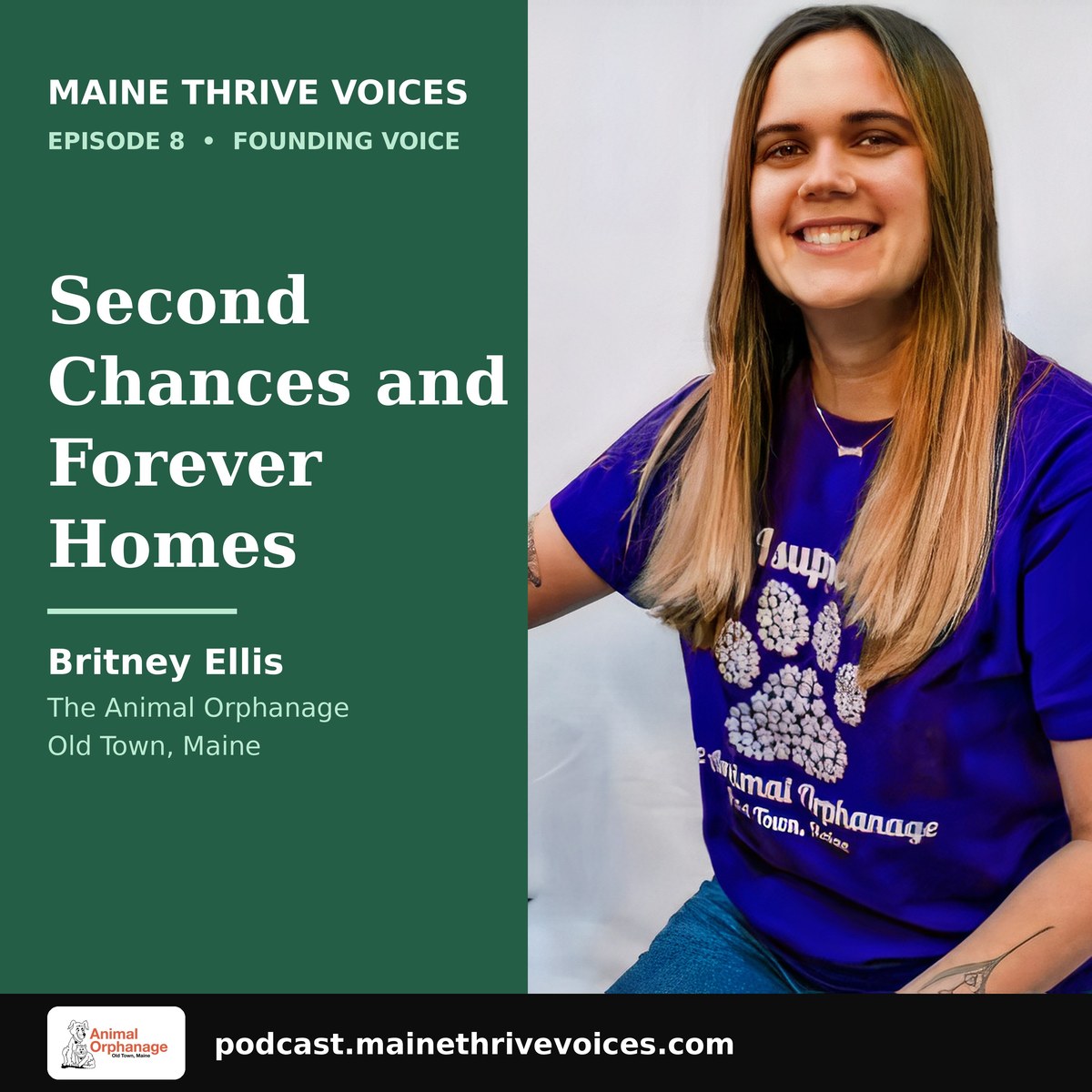
Ask Britney Ellis what she wishes people understood about rescue animals, and she doesn't hesitate.
They're not damaged. They're not broken. They just need someone with the patience to let them show who they really are.
Britney is the Public Relations Specialist at The Animal Orphanage, a small no-kill shelter at 71 Airport Road in Old Town that has been quietly doing this work for 36 years. She sees it every day: a dog labeled “stray” or “aggressive” who, given time and a safe place, turns out to be goofy, affectionate, and desperate to belong. The staff and volunteers get to see that side. Most of the public never does. Her job — and this Insight — is about closing that gap.
A Job Most People Don't Know Exists
A public relations specialist at an animal shelter surprises people. But listen to Britney describe a week and it makes perfect sense. She runs the fundraising and digital marketing, plans and executes every event, chairs a monthly fundraising committee, recruits sponsors and volunteers, partners with local schools to teach kids what rescue work really looks like, manages the website and social media — and still works hands-on with the animals when the shelter needs her.
Britney came to the work as a dog trainer. Before the Orphanage, she ran her own grooming and training business and worked at a doggy daycare. Two and a half years ago she saw an opening at the shelter and never looked back. What surprised her most? How much of the work is invisible. “It's not just hanging out with animals all day,” she says. Behind every adoption photo is a small staff juggling intake, medical care, fundraising, and the endless logistics of keeping a full shelter running.
The results are visible, though. A community-funded campaign put a badly needed new van in the parking lot last winter. The next goal is bigger: an expansion of the building itself, so the Orphanage can help more animals.
What “No-Kill” Actually Means
The Animal Orphanage is a no-kill shelter, and Britney explains the term in plain language. In overcrowded regions of the country — particularly the South — some shelters are forced to euthanize animals simply because there is no room. The Orphanage doesn't do that. Instead, it manages the problem on the front end: limiting intake to what the shelter can genuinely care for, working only with its contracted towns, and taking strays, abandoned animals, and — when space allows — owner surrenders.
Most Maine shelters are now no-kill, something the state can be proud of. But it only works because shelters like this one hold the line on capacity and lean hard on two things: fosters and volunteers.
From Terrified Stray to Family Dog
When an animal arrives — usually through animal control or a police department — the first order of business is calm. A kennel is prepared with a bed, food, and toys. Most animals come in frightened, so the staff gives them time to decompress before a full intake check: teeth, ears, weight, injuries, ticks, anything needing immediate attention. Most arrive as complete unknowns, so the staff reads everything from what's in front of them.
By the time an animal is ready for adoption, the medical work is done. Every animal leaves spayed or neutered and current on rabies and distemper. Dogs are also vaccinated for Lyme and Lepto and tested for heartworm, Lyme, and anaplasma; cats are tested for FIV and feline leukemia. Anything found gets treated.
The proof of the process is in the stories. Britney's favorite is Quinn — a dog who had already been at the shelter two years when Britney started, held back by behavioral quirks no adopter could see past. The community raised the money to send Quinn to a professional trainer, she worked hard, came back, and was adopted a few months later. Today she has a family and a dog sibling of her own.
The One Who's Still Waiting: Meet Rex
The Orphanage has a two-year partnership with WABI TV5, where Britney appears a couple of times a month to feature adoptable animals — and the segment works. Animals who appear on air are typically adopted within a week.
Only one has ever gone on television and come home still waiting. His name is Rex.
Rex is five years old and has been at the shelter over a year and a half. He needs a very specific home: women only, no other pets, no children. With the right person, though, he's a completely different story — playful, affectionate to the point of wanting to climb inside your skin when he cuddles, and the happiest dog on the property when a volunteer takes him out on a Dog Day Out adventure. He always gets the pup cup.
If you're a woman with a quiet home and room in your life for one devoted dog, Rex has been waiting for you specifically.
Three Ways to Help — Even If You Can't Adopt
Foster. Every animal placed in a foster home opens a kennel at the shelter, which means one more animal saved. Foster homes also teach animals — many of whom have never lived indoors — what a home actually feels like. During kitten season, that home setting is where the babies learn to be pets. And for anyone on the fence about adopting, the Orphanage offers a foster-to-adopt week: take a dog home, live with them for seven days, and the shelter provides everything you need during the trial.
Volunteer. The staff is small. Volunteers clean kennels, walk dogs, help at events, and give full-to-capacity dogs the socializing that makes them successful when they finally meet their adopter.
Give. Cash donations go directly to animal care, and the fundraising committee (which meets monthly and welcomes new members and ideas) turns them into vans, training programs, and — soon, hopefully — a building expansion. In-kind donations are welcome too: food for cats and dogs, adults and babies; blankets and towels; kitty litter; toys and treats; medicine; kennels, crates, and beds. (Skip the pillows and sheets — they don't hold up.)
Ready to Meet the Animals?
Britney's advice for anyone on the fence is simple: just come meet them. Hang out, ask every question you have, and let the animal show you who they are before you decide anything.
A few things to know first. Adopters must be 21 or older, established with a veterinarian, and able to show either proof of homeownership or landlord permission for a pet. Any animals already at home need to be vaccinated and spayed or neutered.
The shelter is open Monday through Wednesday and Friday from 1:00 to 4:30, Saturday from 9:30 to 1:30, and Thursday by appointment. Cats free-roam the front space during the day; dogs are available by meet-and-greet in a dedicated outdoor area. You can also find adoptable animals, behind-the-scenes videos, and event announcements on the Orphanage's Facebook, Instagram, and TikTok.
Thirty-six years of second chances, one small building in Old Town, and a waiting room full of animals who aren't broken — just waiting.
Local Resource
The Animal Orphanage — 71 Airport Road, Old Town, Maine
Website: animalorphanageoldtown.com
Email: [email protected]
Listen to the full conversation: Maine Thrive Voices — Episode 8 with Britney Ellis
Community Profile: The Animal Orphanage on Penobscot Valley Thrive
Maine Thrive Voices is produced by Smith Digital Solutions, LLC in Bangor, Maine. Learn more at smithdigitalsolutions.com.