Adam Barker-Hoyt Did the Math
How a university mathematician built one of Maine's most trusted heat pump companies — and why he refuses to join the throwaway culture
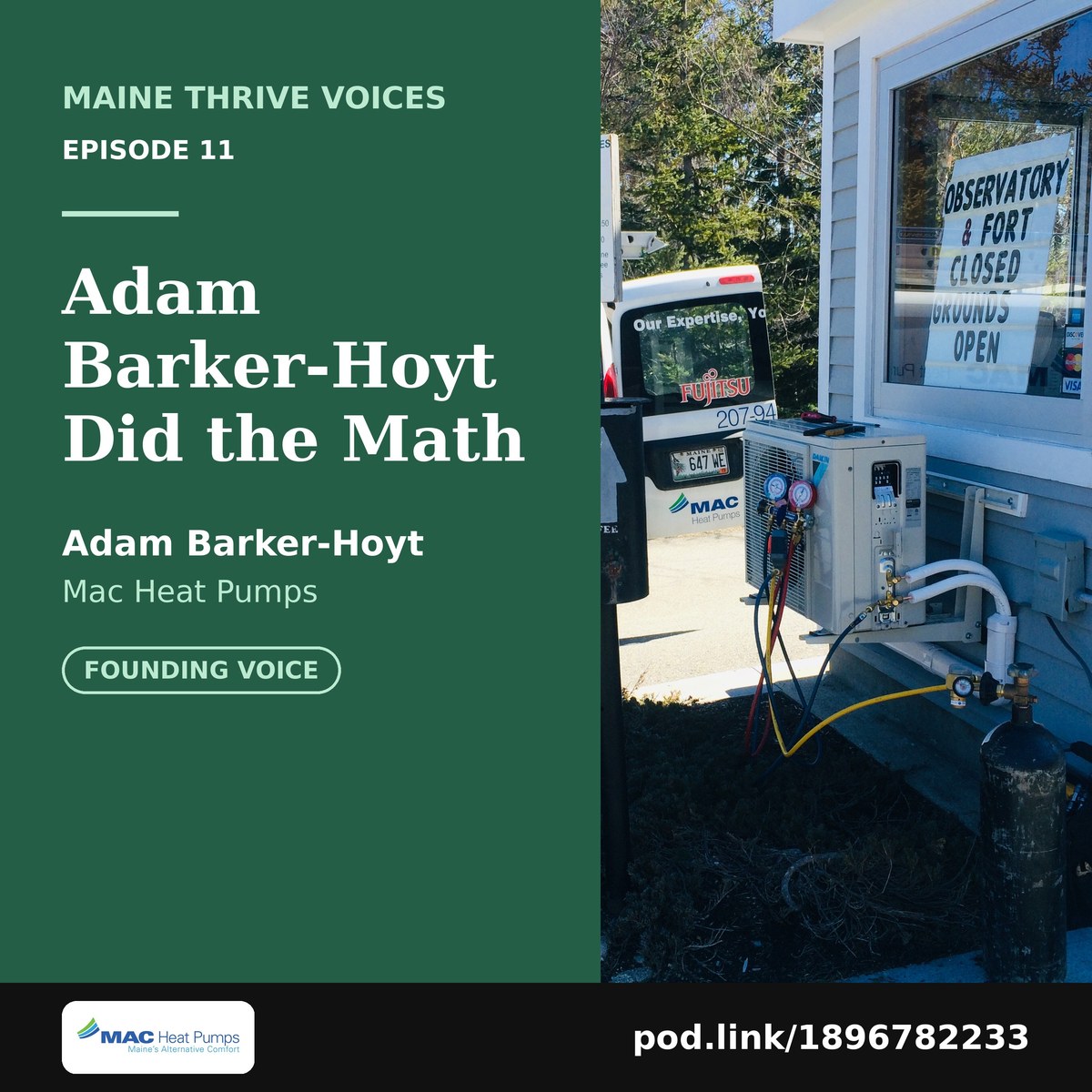
Fifteen years ago, Adam Barker-Hoyt had a master's degree in mathematics, seven years of university teaching behind him, and no interest in leaving Maine to chase a PhD. What he did have was a growing conviction that climate change was the problem worth working on — and a hunch that his math might be useful in the energy industry.
That hunch led him to Jim LaBrecque, one of the state's foremost heat pump experts. Adam shadowed him for a year, unpaid, learning refrigeration from the ground up. At the end of that apprenticeship, he launched MAC Heat Pumps — at a time when most Mainers had never heard of a heat pump, and the few who had assumed the things didn't work.
"I myself hadn't even heard of a heat pump before I started shadowing Jim," Adam admits on the episode. So the early years were about education: showing homeowners how the technology worked, and how it could cut a heating bill roughly in half at a time when oil prices were punishing.
Then came the break. Bangor Hydro rolled out a heat pump rebate program for homeowners — and MAC Heat Pumps was essentially the only company in the region installing them. Adam's company handled roughly seventy percent of those rebates. The numbers that followed sound like a math problem he might have assigned his students: nine installations the first year, sixty-three the second, three hundred sixty the third. Six hundred percent growth, twice in a row. He quit teaching.
What Success Doesn't Look Like From the Outside
Adam is candid about what came next, and it's one of the most honest stretches of the conversation. When demand surged, everyone got into heat pumps — electricians, HVAC firms, oil companies, technicians striking out on their own. The first-mover advantage evaporated. From roughly 2017 to 2020, Adam was working twelve- and fourteen-hour days, seven days a week — one year, he took three days off — while barely making payroll and barely paying his own bills, week after week, for years.
"I never saw quitting as an option," he says. "So I always powered through."
What carried the company out of that stretch wasn't a marketing trick. It was values, applied with the same rigor he'd bring to a proof: integrity — do what's right, especially when no one's looking. Responsibility — own your actions and your team's. Community — the business exists for more than a paycheck. Today MAC Heat Pumps holds an A+ Better Business Bureau accreditation and a 4.9 average across more than five hundred Google reviews, with a leadership team that's been with him for the better part of a decade.
The Honest Answer About Maine Winters
Ask Adam whether a heat pump can keep up at ten below, and you get something rare in a sales-driven industry: nuance. Modern units run at minus fifteen, minus twenty-two, even minus thirty-two degrees — there are households in Aroostook County heating with nothing else. But MAC Heat Pumps still recommends keeping a backup heat source, because every heating system has strengths and weaknesses, and a prudent home has more than one.
His answer for the fence-sitter is pure mathematician: people fixate on the electric bill going up a hundred dollars and never notice the oil bill dropping three hundred. "They're not doing the calculus," he says. Across his entire fifteen years in the business — even when oil was at its cheapest and electricity at its highest — heating with a heat pump has remained the cheapest way to heat a Maine home, with the added benefit that electricity prices stay far more stable than heating fuels.
Repair, Don't Replace
The heart of the episode is Adam's stand against what he calls the throwaway culture. Repairs are hard to make money on, so much of the industry defaults to "you need a new system." MAC Heat Pumps has gone the other way: repairing units others won't touch, running older systems until they genuinely give out, and refurbishing removed units for a second life. A service program the company has been quietly piloting — one that covers repairs for a modest annual cost and makes smart use of tested, refurbished parts — is set to open to all customers next year, whether MAC installed the system or not.
It's the same instinct that has him donating heat pumps to the Together Place and a Bangor food pantry, and quietly carrying customers who couldn't otherwise heat their homes. For Adam, the climate case, the community case, and the business case are the same case. That's not sentiment. That's the math.
Maine Thrive Insights is produced by Smith Digital Solutions, LLC in Bangor, Maine. This Insight is a companion to Maine Thrive Voices, Episode 11.